lunedì 26 settembre 2011

Mintigo reads your customer code to find leads, gets $9M from Sequoia Capital


Sequoia Capital has turned its eyes toward lead generation in its latest investment, Mintigo, a company focused on streamlining the customer acquisition process. The second round of funding was announced today and was capped off at $9 million.
Mintigo describes finding sales leads not as a needle in a hay stack, but rather a needle in a needle stack. There are so many potential customers out there and many of them seem as worthy of a pitch as any. Enter Mintigo’s Customer Code makeup.
Each company has what Mintigo calls a “customer code,” or a make up of traits that form a company’s customer type. Once Mintigo “cracks the code,” the company targets a specific demographic based on your business model, product or service, and industry for potential leads. In essence, it combs through this subset of potential leads and tries to match your code with their codes. Once it has found a match, it sends it to you.
Lead generation has been around since people have exchanged of goods. There are a multitude of companies analyzing sales data, all attempting to make the best formula for saving time wasted cold calling. Companies such as Eloqua all have recipes for using existing contacts to find new ones. But Mintigo is seeing some traction and has been nominated for Microsoft’s BizSpark One project.
Mintigo was founded in 2009 and is located in the US, Spain and Israel. Other investors in this round included Giza Venture Capital and private investors. The company has over 25 employees and plans to use the funding toward expanding its US product.

Quantance raises $11M to create efficient power supply chips for mobile phones


Quantance has raised $11 million to create more efficient power supply chips for 4G mobile phones. While these chips will cost maybe 50 cents to $1, they could play a huge role in making smartphones more powerful and have longer battery lives.
Most power supplies aren’t good enough to deal with the rapidly changing needs of a smartphone, which could be using a little bit of power one second and using a lot the next because the user answers a phone call or initiates an application. The benefit of Quantance’s better power supply chip (pictured right) is that they enable faster data uplink speeds, improved performance, and better network reception for smartphones, tablets and data cards.
“Most of these new phones operate at very high speeds and so they need a power supply that operates at high speeds also,” said Vikas Vinayak, chief executive of Quantance, in an interview. “But batteries and power supplies are too slow. They have not kept up with the consumer’s voracious appetite for accessing mobile content and applications when and where they want them.”
The power supply’s job is to efficiently take power from a battery or a bus and deliver it to various circuits inside an electronics device such as a smartphone or tablet. It must deliver the power in the right amount and do so at a high speed. The problem  is that some existing power supplies can generate voltage efficiently and others do it quickly. But none can do that simultaneously. Most power supplies deliver more power than is needed, because if they deliver less than is needed, an application will fail and you’ll get the mobile equivalent of the Windows “blue screen of death,” Vinayak said. With such overkill, the designer can be certain that a call will never get dropped because of inadequate power moving to the radio. But delivering too much power is inefficient, and it means the device will run out of power too early.
“We deliver the exact amount of power needed in the exact place, because our power supply is so much faster,” Vinayak said.
The San Mateo, Calif.-based company took more than six years to design and prototype its new line of ultra fast power supply chips for smartphones. Those chips came about because Vinayak, a radio frequency and analog design engineer, happened to take an online Stanford University class on mathematical communication theory while he was waiting to get his Green Card. He had a deep interest in communication theory, especially in wireless technologies.
In his spare time, he watched the class via the Stanford Instructional Television Network. As he did so, he realized that the formula that most RF engineers use to calculate efficiency was incorrect. He worked out the correct formula, but he was shocked to find that the correct formula and the industry’s incorrect formula both gave the same number for efficiency — one reason it was never detected. Vinayak then mathematically tried to reconcile the different equations and managed to develop a new one. It turned out the equation could be true only if certain properties were true; and subsequent math simulations proved them to be so.
“With this, I knew how to design the world’s fastest response power supply that was also highly efficient,” Vinayak said. “I loved analog circuits, and found I had to do something totally opposite of what was taught.”
Vinayak formally founded the company in 2006 to build a better power supply. To build its chips, the company has had to gather expertise in analog design, digital signal processing, and radio frequency design. The result was the company created a lot of innovation in a tiny package that is 1.5 millimeters squared in size.
Vinayak patented a technology that combines efficient analog computation with digital switching technology to respond to changes in power supply requires about 100 times faster than other power supplies on the market. Conventional power supplies for 4G smartphones respond at 4 megahertz. But Quantance’s technology works at the equivalent of 400 megahertz, without drastically reducing efficiency. That allows uplink data speeds to be improved as much as three-fold, based on field trials, Vinayak said.
The investors include TD Fund, Granite Ventures, InterWest Partners, and DoCoMo Capital. Eric Zimits, managing director at Granite Ventures, said that Quantance is a leader in a market that could consume 10 billion devices over the next eight years. He expects Quantance’s technology to appear in many 4G devices.
Vinayak acknowledged it was “pretty hard” to convince investors to fund a chip company, since almost no chip companies are raising money these days. But his company jumped through a series of hurdles to earn its credibility. First, the company had to create prototype designs and then produce working chips. The potential customers then offered their feedback on the new features they wanted.
“The technical part was very tough, and then we had to convince companies to take a risk on us,” Vinayak said. “We are lucky to have investors that understood what we wanted to do.”
Quantance had to then go back and redesign its chip and produce more working samples. The whole process took more than six years. By next year, smartphones with Quantance chips are expected to debut in the market. The funding will help the company launched chip production as well as design new chips. Taiwan Semiconductor Manufacturing Co., the biggest contract chip manufacturer, will make the chip for Quantance.
Quantance has 18 employees and it hopes to increase that by 50 percent this year. Most semiconductor companies have tried to create the same technology, but most have given up. Quantance is talking with many of them to be potential customers. A handful of startups also failed, which was why it was so hard to raise money. But now the company has raised its round and an unnamed manufacturer is designing Quantance’s solution into a power supply for a device that will begin prototype production later this year. A carrier will put the mobile device through product trials. Volume production could begin in 2012.
“Most of the companies are talking to us now, and I’m not aware of any company that is ready to ship a production device here,” Vinayak said. “We are the only ones doing this.”

Spotify Surpasses 2 Million Paying Subscribers


Streaming music startup Spotify has added roughly 400,000 paying subscribers since its stateside launch, for a total of more than 2 million paying subscribers across the eight countries it serves.
Spotify CEO Daniel Ek revealed the new figure in a taped interview with CNBC that is set to air in the U.S. Wednesday, a company spokesperson tells Mashable.
Ek will also speak at Facebook’s f8 developer conference Thursday, where he’s expected to reveal details of the company’s rumored music partnership with Facebook.
Spotify announced that it had more than 1.6 million paying subscribers during its U.S. launch in July. The much-buzzed about music startup hit the 1 million paying subscriber milestone in March, meaning it has doubled its paying customer base in just over six months.
By comparison, Rhapsody hit 800,000 subscribers in July and Sony’s unlimited music product counts 750,000 people as paying customers. MOG and Rdio are also both said to be partnering with Facebook on the music initiative to be unveiled Thursday; they’ve yet to disclose subscriber numbers.

3 Ways to Find Top Talent for Your Startup


This  post originally appeared on the American Express OPEN Forum, where Mashable regularly contributes articles about leveraging social media and technology in small business.
While the latest unemployment numbers are unnerving, there are still many companies struggling to find the right employees for their organizations — especially when it comes to startups.
While there’s no such thing as a typical startup — which is why the startup environment is an adventure — one thing is certain: The traditional route of placing an employment ad, accepting resumes, conducting interviews and making an offer isn’t the norm. As evidence, here are the success stories of several startups and how they found the top talent they were looking for.

1. Attend Networking Events


Aaron Harris, co-founder and CEO of Tutorspree, a marketplace for local tutors, discovered that going to specific technical meetups and hangouts can bring success in finding top talent. “That’s not to say we didn’t try a lot of other things that failed rather badly. Most of the general purpose tech gatherings are pretty crummy, filled with people looking for engineers or who are just generally curious about startups.”
Harris says, “The upshot of our experience is we found Paul deGrandis who is, without a doubt, a superstar. He’s an incredible engineer — among other things, he’s a contributor to PyPy, which Quora just adopted — and a great guy.”
When you’re at a networking event and meet that perfect candidate, remember to have your pitch ready. Harris explains:
“We realized that developing a profile of the person we wanted and building the right pitch to excite them was critical. You’re always competing against the bigger tech companies for the best engineers. They have deeper pockets and some unbelievable technology. Startups have to sell the dream of what they’re building and the ownership that goes along with it. When you figure out the right way to sell that, then you’re ready to close the candidates when you find them. At every stage, you need to convince the candidate as much as they need to convince you.”
And if you can’t find an event to attend, don’t be afraid to create your own. That’s what I Love Rewards, an SaaS-based employee recognition solution, is doing to fill positions for their San Francisco office. Razor Suleman, founder and CEO, says the company was hosting bi-weekly cocktail parties and happy hours at the swanky W Hotel in downtown San Francisco so job seekers could meet with current employees and executives and get a feel for company culture and expectations.
Suleman cited the nerve-racking interview-like scenarios as the reason for the event. “With recruiting happy hours, we alleviate the pressure for the talent and provide them with a fun and positive experience. Candidates can network and mingle in a great atmosphere and that way, if their takeaway isn’t a career opportunity at I Love Rewards, they still have a positive experience with the company and opportunity to network with other people.”
But all this fun doesn’t come without a downside — time. Suleman explains, “I Love Rewards’ recruiting and interview process is extremely diligent to ensure that we can find true A-players who will drive our business success and contribute to our unique company culture. Because of this, our interview process is longer than most organizations, taking nearly double the time to hire one person as it does for most other organizations. Although we have a rigorous process, it’s a price we are happy to pay to find the right person; after all one A-player is more effective than five B-players.”

2. Work Your Personal Network


Profitably CEO and founder Adam Neary says all of their recruiting comes from doing it the hard way — networking like crazy. “We’ve had zero luck with websites, zero luck with networking events and zero luck with social media.”
Neary tells the story of when Profitably, a New York based startup that helps small businesses free themselves of Excel when it comes to planning, managing and executing their business, was looking for an engineer. “When I was getting started, every other entrepreneur I knew was spending every conversation talking about their idea. I felt and still feel like ideas are cheap, and so I asked every engineer I knew who was the smartest engineer they knew. Half of the people said without hesitating, ‘I am.’ Interpret that as you will. But the other half said, ‘Francis Hwang.’ And those who said ‘I am,’ named Francis second. It was statistically improbable how many people held Francis in that regard. So, tactically, I had six different engineers introduce me to him, and he took the meeting. I courted him for three months before he quit his job. Now’s he’s our CTO and he rocks.”
That personal networking philosophy extends beyond the recruitment process. Neary explains, “We make it really tough to get into Profitably, but once you’re in, you’re family. We pay 100% of employees’ health insurance. We let them buy whatever hardware they like. But the ‘family’ component comes from working well together, not just being smart. By tapping people’s networks, we have much earlier and much more qualified sense of what that looks like, and by making sure everyone in the team is involved with every hire, we continue to cement our culture as we grow.”
While often times startups have to work their connections to find talent, sometimes the talent is right in front of them. Such was the case at Thumbtack.com, an online marketplace for local services like home contractors, wedding photographers, SAT tutors, etc. Sander Daniels, co-founder of Thumbtack.com tells the story of how he found his lead engineer. “Two years ago, one of our CEO’s friends introduced us to an engineer from a big tech company. We didn’t think much of it — he was happy with his job, and we weren’t looking to hire anyone at the time.
However, he started coming to our offices on Friday nights to hang out with the team. We provided the drinks and the fun conversation. He saw over time how we talked about our company — how excited we were about our progress, how rapidly we improved our product, how big our dreams were. Although neither of us intended it, he soon caught the startup bug. Skip ahead two years to today — he’s now our lead engineer. And he also recruited his roommate — another big tech firm engineer — to our team.”
It’s tough to persuade superstar talent to leave their safe jobs at big tech companies for the big risk of a startup. “We’ve found this can only be done in a social setting — the more they hang out with your team, the more they see your excitement,” Daniels says. “Soon they’ll catch the bug too.”
When it comes to personal networks, Adrian Salamunovic, co-founder of DNA11, the original creator of DNA Art, believes the key is staying connected with remarkable people even when you don’t have an opening. That’s how he found their public relations manager. “We met at a 40 Under 40 awards gala over a year ago. I knew she was a superstar, and we stayed in touch via emails, Twitter and Facebook. I eventually convinced her to come in for an interview, and she joined the company a few months ago.”

3. Make Your Company a Great Target


Finding talent doesn’t always have to be about companies making the first move. Creating an environment that entices candidates to come work for you is a very sound strategy (and great perks help). Jason Henrichs, chief operating officer of PerkStreet Financial, a firm changing the banking business by giving customers rewards and tools for spending responsibility, says superstars find them versus the other way around. “Our head of community development was a customer first and then sent us a passionate letter about why she wanted to work at PerkStreet. Those who weren’t customers have come to us through our network that evangelizes the PerkStreet mission to fix banking for the average American — over half our team was recruited this way.”
Henrichs attributes this to creating a culture with a high emphasis on value, not just doing things. “Recruiting based on a specific job description puts the emphasis on the task an individual will perform, versus our approach which requires a joint prioritization about where this new team member can drive the biggest return. The stars on our team have helped define the roles they fill.”
Another way to effectively bring talent to your doorstep is with an employee referral program. Ryan Howard, chief executive officer at Practice Fusion, a fast-growing electronic medical records community in the U.S., says their “intellectual athletes” (a.k.a. employees) are well-versed in the company’s core values, which include “be scrappy,” “give to your community” and “exhibit integrity with no compromise.” To thank employees for candidate referrals, Practice Fusion offers monetary rewards ranging from $2,000 to $10,000, depending upon the position.
Practice Fusion is adding more than 10 employees a month. Even with their rapid growth, it places a tremendous emphasis on finding talent that is a great cultural fit and who will continue to grow with the company. Howard has a goal for zero attrition, ensuring that each person at Practice Fusion has a career path, a voice and a true passion for the company.
In addition to their career path, employees at Practice Fusion participate in an internal mentorship program connecting executives with younger colleagues to shape future career growth. A monthly “Phenomenal Friday” event is dedicated to independent projects, presentations and shared meals. Their kitchen is stocked with healthy food and the latest newspapers. Lunch and dinner are catered. Employees have health stock option plans. Dogs are welcome at the office, and cubicles are banned. According to Howard, “All of these pieces not only help find talent but keep it.”
No matter what kind of startup you are, the rules to finding talent come down to one thing — who you know. It’s about getting out and meeting people, staying connected and spreading the word about what a terrific organization you are. In fact, as your organization grows, you’ll find this really doesn’t change. It’s all about meeting top talent, finding a couple of chairs and saying “Let’s talk.”

sabato 24 settembre 2011

Free Startup Docs: How Much Equity Should Advisors Get?


It’s an age-old scenario: You’re building a company, you have a product idea, and you’ve got the framework laid out in your head, but you want some expert advice and guidance on how to take the next steps. So, you go out to find a veteran entrepreneur, ask her to be an advisor in your fledgling company … and then what?
This is where a lot of founders get stuck. Entrepreneurs want to compensate their mentors and advisors for the time they dedicate to helping their businesses grow, but they have no idea how much equity to offer. Not to mention, once the founder and advisor have nominally agreed to a relationship, law firms enter the mix and seed the new advisor with a mountain of paperwork — legal agreements, options agreements — documents stuffed with legalese and binding statements. Just this hassle alone is sometimes enough to scare an advisor away from the relationship, at which point both sides lose.
So, the Founder Institute has developed a solution to this long-standing pain in the ass that all startups experience. After speaking with dozens of founders, mentors, advisors, and startup teams, the startup accelerator and network is publicly releasing what it calls the “Founder Advisor Standard Template” (FAST), a free document designed to provide founders and advisors with a simple legal framework to formalize their relationship without all the legal chaos.
“We’ve been seeing at least one post per week on TheFunded concerning mentor compensation”, said Adeo Ressi, the founder of both Founder Institute and TheFunded.com (a site focused on revealing the inside truths of the Venture Capital world). Having to invent ad hoc terms to work together, negotiating terms, and throwing money into hiring lawyers can really hamstring the formation of productive founder-advisor relationships — something that can really make or break a startup in its early stages.
This is where FAST enters the picture, which Founder Institute has developed in conjunction with the Orrick Law Firm and Silicon Valley entrepreneurs, to standardize the process and remove the hassle, cost, and delay to the formation of these relationships. Now, with a few signatures and a couple of checkmarks, founders and advisors can decide (in minutes) how they want to work together, what to accomplish, and how much equity will be in play.
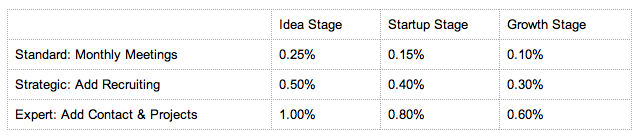
In an effort to standardize the process with FAST (and let everyone just get back to building great companies), Founder Institute and Orrick have denoted three “levels of company maturity” that have different implications for how to define the advisor-founder agreement: idea, startup, and growth. In addition, they qualify the terms with three “levels of engagement” that define how advisors will work with founders and have varying influence on how they are compensated: standard, strategic, or expert.
For example: If an advisor meets with the founding team monthly, is involved in recruiting talent for the business, and takes a few customer calls, then that advisor would be entitled to 1 percent of the company in the form of restricted stock or options, vesting over a two-year time frame. For a growth stage company, in comparison, this level of engagement would earn an advisor 0.6 percent.
What’s more, the idea here is that the agreement is codified by the two parties in such a way that it meets the minimum legal requirements but is flexible enough to allow advisors to end the relationship in as little as five days, for example. Traditionally, both beginning and terminating these contracts can take weeks — even months.
But what’s so cool about this is that, in the spirit of this flexibility, the team is architecting the document by way of crowdsourcing. This means that, until they finalize the agreement (Ressi tells me that the target date is September 30th), they will be taking the input of readers, founders, startups, and beyond, incorporating the best feedback into its development. In particular, Ressi said, the team is interested in reactions to the above equity matrix.
So what do you think? Does this seem like a sound system and a fair method of compensation? Let us know in the comments section, where members of the Institute will respond.

Motor City Mojo: The Startup Renaissance In Detroit


Editor’s note: This post is authored by guest contributor Jon Bischke. Jon is a founder of RG Labs and is an advisor to several startups. You can follow Jon on Twitter here.
I heard them say they’re shutting Detroit down.
But I won’t leave ‘cause this is my hometown.
– Kid Rock, “Times Like These”
San Francisco. Palo Alto. New York. Cambridge. Austin. Boulder. Detroit. One of those doesn’t seem to fit in there right? After all, Detroit’s a mess isn’t it? The median house price in Detroit is $6,000. Half of the adults in the city are functionally illiterate48% of children live below the poverty line. Some people would say that Detroit epitomizes what is wrong with America.
But for a group of talented and motivated entrepreneurs in Detroit it’s something else. It’s a chance to show what’s right about America. Last week I had the pleasure of meeting with a dozen of Detroit’s top founders to discuss what it’s like to start a company in what’s probably the most economically depressed city in the country. While their businesses were different and they didn’t agree on everything, they all shared one thing: a strong feeling that the Detroit of the future will be better than the Detroit of the present.
The meetup came together in large part due to the efforts of Ben Bator, the founder of Texts from Last Night, a somewhat random idea that spawned a website with four million monthly unique visitors,a book and a development deal with Sony Television. Ben is the kind of the guy who could start a company anywhere but instead has chosen to grow his company in Detroit and help to provide jobs in the community that he grew up in.
If that attitude sounds familiar it might be because of a guy named Dan Gilbert. Gilbert, a Detroit native, founded Rock Financial back in the 80s and the company was acquired in 2000 by Intuit and rebranded as Quicken Loans. In 2010, Quicken Loans moved its headquarters and 1,700 employees to downtown Detroit and plans to move an additional 2,000 people downtown by the end of this year.Estimates of Gilbert’s wealth have exceeded a billion dollars, plenty of money for him to buy the Cleveland Cavaliers and perhaps more importantly plow some of his cash back into the Detroit startup scene through Detroit Venture Partners (DVP).
Jake Cohen, who joined DVP in November, feels that Detroit is on the verge of a startup renaissance. “There are a number of advantages to starting a company in Detroit including lower costs, strong talent at the local schools like the University of Michigan, Michigan State and the College for Creative Studies at Wayne State and an an opportunity to fill a local hiring void left by the downsizing of the auto industry.” DVP has written checks for 10 companies in the last year alone and the company’s roster of investors includes impressive guys including Josh Linkner, DVP’s CEO and founder of the ePrize and, most recently, Michigan’s favorite son, Magic Johnson, who joined as a General Partner in July.
The renaissance in Detroit is one that spans generations. It includes guys like Andrew Rauh, a guy who Peter Thiel should be actively recruiting for his 20 Under 20 program. Andrew, a freshman at the University of Michigan, has already started one company and been featured by Fast Company. Andrew’s resume is one of the most impressive of any teenager I’ve encountered and includes being published by Johns Hopkins University, finishing 3rd in an International Science Fair and raising money for Haiti after the earthquake.
But it’s not just young guys starting companies in Detroit. Hossein Nivi might be a bit older than your average tech entrepreneur but he’s no less visionary. Hossein is attempting to disrupt education and training through Pendaran. Imagine a cross between a flight simulator, a boot camp and a business school and you have a highly effective training model that’s been used within a number of corporations. And if Hossein’s surname is recognizable, it’s likely because you’ve seen the work of his sons out in San Francisco, Babak (“Nivi”), the founder of AngelList, and Farbood, the founder ofGrockit.
So while it’s easy to look at Detroit and feel discouraged by what’s going on, spend an hour with one of Detroit’s entrepreneurs and your mindset will change. Raji Bedi, the founder of doingtonight(think Plancast for where you’re going out tonight), put it well with an emphatic statement. “We don’t want your pity or to be someone’s charity project. We want Detroit’s startup companies to stand on their own.”
After spending time with the founders of other innovative companies like Are You a Human (game-based CAPTCHA), Gumshoe (a social game best described as “Clue meets The Amazing Race”),HealPay (disruptive play in the collections space) and Own Point of Sale (social point of sale) and with the people behind incubators like Detroit Labs and Tech Town I was left with a strong sense of hope for Detroit. The numbers are pretty clear. Job growth comes from startups. So if Detroit is to come back it’ll be the founders that assembled last week (and hopefully many more who will follow in their footsteps) who will be part of driving that job growth.
No pity here. The kids in Detroit are definitely alright.

giovedì 22 settembre 2011

Kublai camp

Also this year there will be an opportunity to meet and debate for all community members, designers and not participating in the daily life of Kublai: it arrives at the third edition of the Kublai Camp, part of which is assigned the Kublai Award.The event is scheduled for September 24, 2011 in Rome, from 10 to 18, in the prestigious MAXXI in Rome.The program revolves Kublai Camp 2011, this year, around three concepts: to discover, learn and interact and will be divided after the presentation of the finalists in a series of seminars (on topics of social innovation, funding, public andindividuals, start-up) and technical workshops (how to write a business plan, what to do / avoid the creation of businesses, such as managerial skills to be developed). In closing the ceremony of Kublai Award 2011, the project that has been most appreciated by the jury and the community for its level of creativity and social innovation.
THE PROGRAM September 24AUDITORIUM MAXXI9.30 Registration Participants
KUBLAI CAMP 2011 10:00 - Welcome address: Pauline (Ministry of Economic Development) and Luigi Gallo (Invitalia)
10.15 KUBLAI AWARD 2011 - Presentation of the finalists:Fund for Culture and Adriana Scuotto Antonio ScarpatiThe KIWI-Laura DurantiProCivibus Marco Palace. Strite Libera Mariella TavaglioneAlice Triddles Roncagli and Antonio SicaA book in the sea of ​​Serena Ferrara
Introduction by Nicola Salvi (Invitalia)
11:00 Re-creation
SOCIAL STARTUPPING 11:45 - Round Table: "The success of projects that stimulate social participation: the contribution of the paradigm"
Moderator: Charles Infante (journalist)Participants: Stephen Council (University Federico II, Napoli), Dario Carrera (The Hub), Marco Traversi (I-SIN), Alfonso Molina (Digital World Foundation)
Success Story: "Angels for Travelers" - Stephen Council
Lunch @ 13:00 MAXXI21
EASY START-UP 14:00 - Round Table: "Public and Private Funding Opportunities: paths to follow or avoid the creation of enterprise"
Moderator: Lina D'Amato (Invitalia)Participants: Andrea Genovese (Wind Business Factor), Alessandro Palmitelli (Invitalia), Paolo Cellini (Innogest Sgr)
Success Story: "B.T.R. Studios "- Richard Rosapepe
15:15 Re-creation
T +1 15:45 OPEN MEETING: DISCUSS THE direction to give to KublaiChair: Tito Bianchi (Ministry of Economic Development)Participants: Gian Paolo Manzella (Province of Rome) and David Osimo (Expert Open Government)
17:00 Re-creation
17:15 N INTERACTIVE GAMES - The Speed-Networking awards and Pitch ClubKUBLAI AWARD 2011 - The award ceremony, Louis Mastrobuono (Ministry of Economic Development)
17:45 Closing of the Camp

MAXXI BASE
12:15 to 13:00 THE LESSON: "How to write a business plan - The Business idea," Daniela Patuzzi (Invitalia)
14:00 to 15:00 INTERACTION GAME - Pitch Club: Challenges in 200'', Frederick Albert (Invitalia)
15:00 to 15:45 Lesson II: "How to write a business plan - The economic and financial sustainability of an idea," Daniela Patuzzi (Invitalia)16:15 to 17:00 LESSON III: "The management skills necessary for a start-up," Michele Costabile (Luiss LED-Center)
 
For security reasons MAXXI you must register to participate in the Camp, also here only if you sign up you with the badge, when you register at the desk, a discount (from 11 to 8 €) to visit the museum's collections MAXXISee you September 24th!